

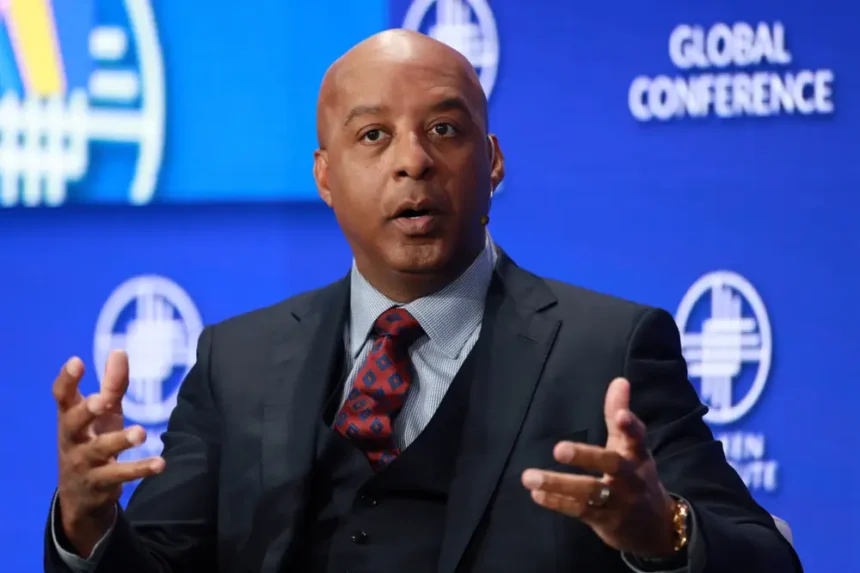
With artificial intelligence fundamentally reshaping the global job market, Marvin Ellison, the chief executive of Lowe’s, has a simple message for both workers and the companies that employ them: Embrace technology or perish. Those who keep their businesses close to customers will succeed even in an increasingly automated world.
Ellison has decades of leadership experience at companies including Home Depot, Target and now Lowe’s in an era of transformation. But five years from now, he says the changes being engendered by AI will be faster and more transformative than anything retail has seen in the past.
Even so, he’s hopeful if people are willing to adjust.
The AI Disruption Is Coming (but Not for What You Think)
From AI-supported chatbots to predictive inventory management and robotic automation in logistics – artificial intelligence (AI) is already shaping the future of operation for retail businesses.
At Lowe’s, Ellison says AI has become an indispensable tool, aiding in forecasting demand, optimizing supply chain and providing personal customer service. But he’s rapid to add that tech is only the beginning.
“If we work and evolve with AI, jobs will change rather than disappear,” Ellison said.
The solution, he said, is how companies retrain and reskill workers and for the employees to be focused more on human-centered roles that machines can’t do.
Why ‘Customer Obsession’ Is the Best Job Security
Although AI has the ability to comb data and optimize operations, it is missing one important characteristic: empathy.
In retail, Ellison said human connection will never be replaced. Something magic happens then, when a store associate is walking the first-time homeowner through installing the stove in her own kitchen for the first time, or when a designer helps a client plan out every detail of a new kitchen. Those one-on-one moments build trust and brand loyalty in ways no algorithm can compete with.
“If you know your customer, if you provide a solution for them, there’s always room,” he said.
Which is why Ellison is trumpeting his team along with a larger workforce to double down on soft skills, from communication and problem solving to emotional intelligence. These aren’t merely “nice to have” skills in the age of AI they’re absolutely necessary differentiators.
Training the Workforce of Tomorrow
Lowe’s already has taken some steps to prepare its workforce for the future. The company provides programs to upskill the employees, so that they would be able to learn new technology, digital tools and customer engagement process.
But Mr. Ellison contends that other businesses should do the same: not just replacing jobs with tech, but investing in people to work with that tech.
That approach is not just good ethics, he says; it’s good business.
‘When employees feel supported and capable, they deliver superior customer service. And that is how you grow a company, even in difficult times,” he said.
What Other Leaders Can Learn
In an environment dominated by headlines about layoffs, job automation and tech disruptions, Ellison is a contrast — emphasizing workforce development over short-term cost cuts.
He thinks that the businesses that maintain a focus on employees and customers, and who embrace change instead of dreading it, are the ones that will emerge stronger from the AI revolution.
And for workers in every field, the advice is simple but potent: keep yourself curious; keep yourself adaptable; and never lose sight of the human side of your work.
The Future of Work: Man + AI
Ellison’s vision is not a response to automation denialism, and it’s not pretending that AI won’t transform the job market. It’s a search for that middle ground between human and machine using tech that enhances people, rather than replaces them completely.
He envisions a future where teams depend on AI to manage the background buzz, and humans focus on relationships, strategy and creative challenges.
That’s not just surviving it’s a recipe for thriving in the next generation of work.